
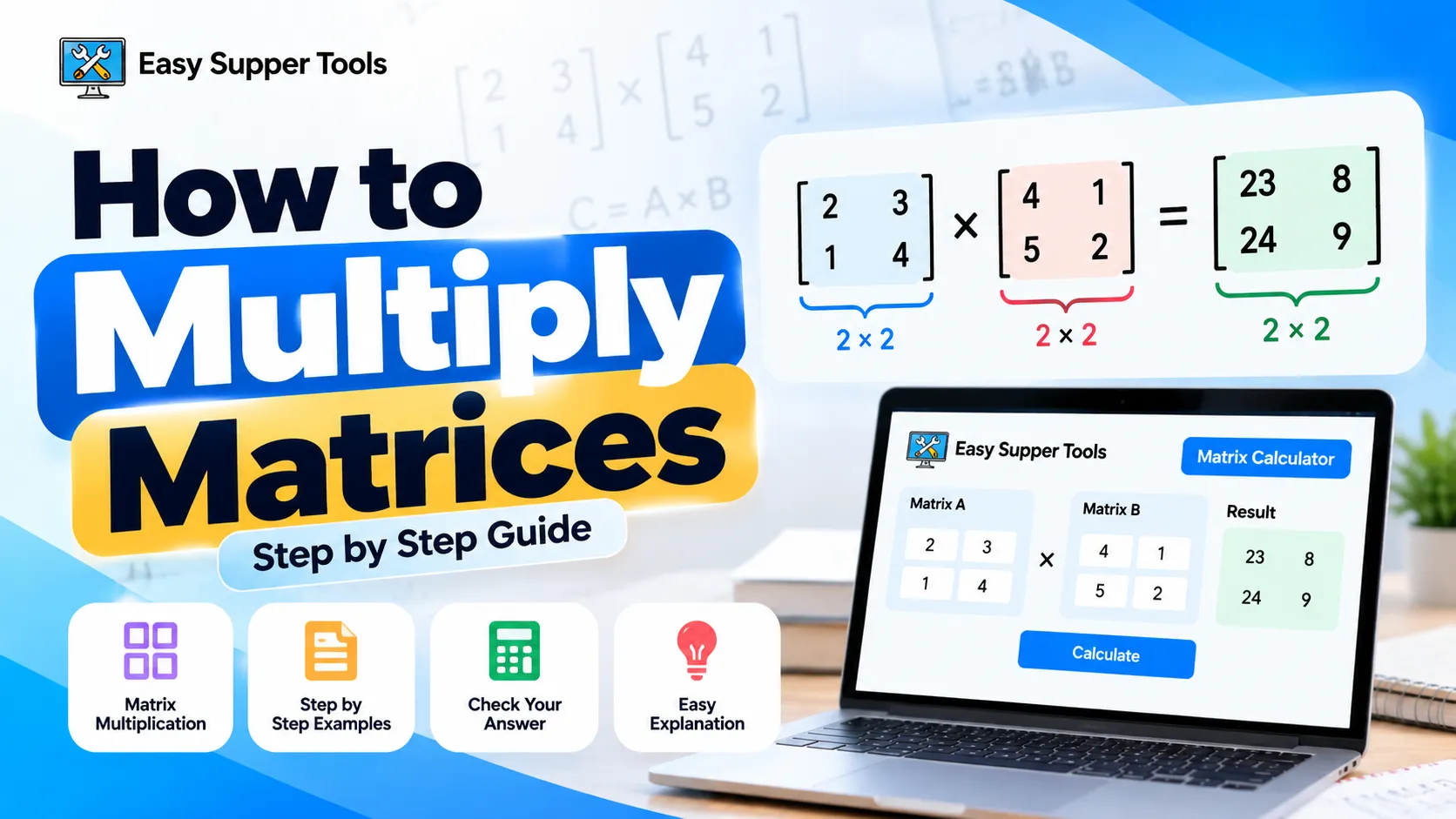
If you want to know how to multiply matrices, start with one rule: take a row from the first matrix, multiply it by a column from the second matrix, then add those products together. It can look confusing the first time you see several rows and columns on the page, but the pattern itself is pretty consistent.
Before doing any arithmetic, check the dimensions. The number of columns in the first matrix must equal the number of rows in the second. If those numbers do not match, standard matrix multiplication cannot be performed.
This guide breaks down how to multiply matrices using simple examples, including 2 x 2 matrices, matrices of different sizes, scalar multiplication, multiplication order, and ways to check your work.
What Does Matrix Multiplication Mean?
A matrix is a rectangular arrangement of numbers organized into rows and columns. Each number inside it is called an entry or element.
When people first learn how to multiply matrices, they sometimes assume they should multiply numbers sitting in matching positions. That is not how standard matrix multiplication works.
Instead, every entry in the resulting matrix comes from one row of the first matrix and one column of the second.
A simple way to remember it is:
Row x Column = One Entry
Suppose you have this row:
[2, 3]
and this column:
[4, 5]
Multiply the matching numbers and add them:
(2 x 4) + (3 x 5)
8 + 15 = 23
So 23 becomes one entry in the new matrix.
Khan Academy’s matrix multiplication guide explains the same row-and-column approach and distinguishes matrix multiplication from simply multiplying corresponding entries.
Once that basic pattern makes sense, the rest mostly comes down to keeping track of where each row and column belongs.
When Can You Multiply Two Matrices?
Before thinking about how to multiply matrices, check whether the matrices are compatible.
Suppose matrix A has dimensions:
m x n
and matrix B has dimensions:
n x p
Then you can multiply A by B because the two inside dimensions match.
The product will have dimensions:
m x p
So:
(m x n)(n x p) = m x p
For example:
(2 x 3)(3 x 4)
This multiplication is valid because the first matrix has 3 columns and the second matrix has 3 rows.
The result will be:
2 x 4
Now look at:
(2 x 3)(2 x 4)
This does not work in standard matrix multiplication because the inside dimensions are 3 and 2.
OpenStax’s matrix operations lesson gives the same compatibility rule: the number of columns in the first matrix must equal the number of rows in the second matrix.
A useful memory trick is to look at the four dimension numbers.
Inside numbers: tell you whether multiplication is possible.
Outside numbers: tell you the size of the answer.
That quick check can save you from doing several lines of unnecessary arithmetic.
How to Multiply Matrices Step by Step
The easiest way to learn how to multiply matrices is to follow the same routine every time.
Step 1: Check the Dimensions
Write down the dimensions of both matrices.
If the number of columns in the first matrix equals the number of rows in the second, continue. Otherwise, stop because the product is not defined in that order.
Step 2: Take the First Row
Start with the first row of the first matrix.
Keep that row while you move through the columns of the second matrix.
Step 3: Pair It With the First Column
Take the first column of the second matrix.
Match its entries with the entries in your selected row.
Step 4: Multiply Matching Entries
Suppose the row is:
[a, b]
and the column is:
[e, g]
Calculate:
(a x e) + (b x g)
Step 5: Add the Products
The total becomes the first entry in the product matrix.
Step 6: Move to the Next Column
Keep the same row from the first matrix, but use the second column from the other matrix.
Repeat the multiplication and addition.
Step 7: Repeat for Every Row
Once you have used all the columns, move down to the next row in the first matrix.
Continue until every position in the answer matrix has been filled.
This row-by-column routine is the main thing to remember when learning how to multiply matrices.
After doing a calculation manually, you can use the Easy Supper Tools Matrix Calculator to compare your answer with an online calculation.
Doing the work yourself first makes the calculator more useful because you can spot where a wrong answer came from instead of only seeing the final result.
How Do You Multiply 2 x 2 Matrices?
A 2 x 2 example is probably the easiest place to see how to multiply matrices in practice.
Take these matrices:
A =
[1 2]
[3 4]
B =
[5 6]
[7 8]
Both matrices are 2 x 2, so the inside dimensions match. The result will also be a 2 x 2 matrix.
Start with the top-left entry.
Use the first row of A and the first column of B:
(1 x 5) + (2 x 7)
5 + 14 = 19
So the first entry is 19.
For the top-right entry, keep the first row of A but move to the second column of B:
(1 x 6) + (2 x 8)
6 + 16 = 22
Now move to the second row of A.
For the bottom-left entry:
(3 x 5) + (4 x 7)
15 + 28 = 43
For the bottom-right entry:
(3 x 6) + (4 x 8)
18 + 32 = 50
The finished product is:
AB =
[19 22]
[43 50]
Notice that we never simply calculated 1 x 5, 2 x 6, 3 x 7, and 4 x 8 and stopped there.
Each answer came from an entire row and an entire column.
If you’re still getting comfortable with how to multiply matrices, repeat this example without looking at the solution. Once you can rebuild all four entries yourself, larger matrices become much easier to follow.
How Do You Multiply Matrices of Different Sizes?
Two matrices do not have to be the same size.
This trips people up because many early examples use square matrices, but how to multiply matrices depends on compatible dimensions, not matching shapes.
Take matrix A:
[1 2 3]
[4 5 6]
A is a 2 x 3 matrix.
Now take matrix B:
[7 8]
[9 10]
[11 12]
B is a 3 x 2 matrix.
The multiplication works because A has 3 columns and B has 3 rows.
The answer will be 2 x 2.
For the top-left entry:
(1 x 7) + (2 x 9) + (3 x 11)
7 + 18 + 33 = 58
For the top-right entry:
(1 x 8) + (2 x 10) + (3 x 12)
8 + 20 + 36 = 64
Now use the second row of A.
Bottom-left:
(4 x 7) + (5 x 9) + (6 x 11)
28 + 45 + 66 = 139
Bottom-right:
(4 x 8) + (5 x 10) + (6 x 12)
32 + 50 + 72 = 154
So:
AB =
[58 64]
[139 154]
This example shows why checking dimensions matters more than asking whether two matrices look similar.
A 2 x 3 matrix and a 3 x 2 matrix can be multiplied perfectly well in this order.
What Is the Difference Between Matrix and Scalar Multiplication?
Scalar multiplication is much simpler than multiplying one matrix by another.
A scalar is a single number. When a scalar multiplies a matrix, that number multiplies every entry in the matrix.
For example:
2 x
[1 3]
[2 4]
gives:
[2 6]
[4 8]
There is no row-by-column process here. You simply multiply every entry by 2.
Matrix multiplication works differently.
When you’re learning how to multiply matrices, you take rows from the first matrix and columns from the second matrix. You multiply matching entries and then add those products.
So remember:
Scalar multiplication: one number times every entry.
Matrix multiplication: row times column, followed by addition.
These two operations are easy to mix up when you’re new to matrices.
If you see one ordinary number outside the matrix, scalar multiplication is probably involved. If you see two matrices being multiplied, start checking dimensions and preparing the row-by-column method.
Does the Order Matter When Multiplying Matrices?
Yes. Order matters.
If you’re learning how to multiply matrices, do not assume that AB and BA will give the same result.
With ordinary numbers:
3 x 4 = 4 x 3
Both equal 12.
Matrices generally do not behave like that.
Suppose A is a 2 x 3 matrix and B is a 3 x 2 matrix.
AB is defined:
(2 x 3)(3 x 2)
and the answer is 2 x 2.
Now reverse them:
(3 x 2)(2 x 3)
BA is also defined, but its answer is 3 x 3.
The two results cannot be equal because they do not even have the same dimensions.
In other examples, both products might have the same dimensions but still contain different values.
There are also cases where AB exists but BA does not.
That is why a problem that asks for AB should be solved in that exact order.
Do not switch the matrices just because one direction looks easier.
A useful rule is:
Treat matrix order as part of the problem.
What Are the Most Common Matrix Multiplication Mistakes?
Most matrix multiplication mistakes are not caused by difficult mathematics. Usually, a small step gets skipped.
The first common mistake is forgetting to check dimensions.
If the inside dimensions do not match, there is no standard product to calculate.
Another mistake is multiplying corresponding entries directly. That is not the standard method for how to multiply matrices.
Other common errors include:
- Using row by row instead of row by column
- Forgetting to add the individual products
- Putting an answer in the wrong position
- Switching the order of the matrices
- Losing a negative sign
- Making a simple multiplication error
- Making an addition error after multiplying correctly
- Assuming AB is always equal to BA
- Writing the wrong dimensions for the result
- Moving to the next row before finishing all columns
One small habit can help a lot.
Think:
Row, column, multiply, add.
If the numbers get messy, write each calculation on its own line.
For example:
(2 x -3) + (5 x 4) + (-1 x 6)
is much easier to check when it is written clearly instead of being done mentally.
Taking a few extra seconds with each entry often saves you from having to redo the entire matrix.
How Can You Check Matrix Multiplication Answers?
Once you understand how to multiply matrices, checking your result is pretty straightforward.
Start with the dimensions.
If A is 2 x 3 and B is 3 x 4, the product must be 2 x 4.
If your answer has a different size, you already know something went wrong.
Next, recalculate one or two entries.
The top-left entry is a good place to start because it comes from the first row and first column. Then choose another entry from farther down the matrix.
Check that you used the correct row, the correct column, and all the required terms.
You can also use an online calculator to verify the finished product. This works especially well when the matrix contains negative numbers or several rows and columns.
If you’re working through other calculation topics, the Easy Supper Tools Mathematics section can also help you find related browser-based math tools.
The best approach is still to solve a few problems manually first.
A calculator tells you whether the answer matches. Understanding the row-by-column process tells you why it matches.
Frequently Asked Questions About Matrix Multiplication
What is the easiest way to multiply matrices?
The easiest way to understand how to multiply matrices is to check the dimensions first, then work one row and one column at a time.
Multiply matching entries, add the products, and place that result into the correct position.
Finish every column for your current row before moving down to the next row. This keeps the process organized and makes it less likely that you’ll mix up entries.
Can you multiply a 2 x 3 matrix by a 3 x 2 matrix?
Yes.
A 2 x 3 matrix has 3 columns, while a 3 x 2 matrix has 3 rows. Since those inside dimensions match, the multiplication is valid.
The answer will be a 2 x 2 matrix because the outside dimensions are 2 and 2.
This is a useful example because it shows that matrices do not need to have identical dimensions before you multiply them.
Can you multiply matrices with different dimensions?
Yes, as long as the inner dimensions match.
If matrix A is m x n and matrix B is n x p, then AB can be calculated and the answer will have dimensions m x p.
For example:
3 x 4 multiplied by 4 x 2
produces:
3 x 2
If the number of columns in the first matrix does not equal the number of rows in the second, you cannot perform standard matrix multiplication in that order.
Why is AB not always equal to BA?
Matrix multiplication is not generally commutative.
Changing the order changes which rows are paired with which columns. Sometimes both AB and BA exist but produce different answers. In other situations, only one of the two products is defined.
That is why order is one of the most important details to watch when learning how to multiply matrices.
Can I use a calculator to multiply matrices?
Yes. A matrix calculator is useful for checking homework, verifying larger calculations, and catching arithmetic mistakes.
It can be especially helpful when the matrices contain several rows, negative values, or decimals.
Still, if you’re learning how to multiply matrices, work through some examples by hand first. Once you understand how each entry is created, a calculator becomes a useful checking tool instead of something that simply gives you an unexplained answer.
Once the row-by-column pattern clicks, how to multiply matrices becomes much easier to manage. Check the dimensions first, take a row from the first matrix and a column from the second, multiply matching entries, add the products, and place the result carefully. If you’re still getting used to how to multiply matrices, start with a simple 2 x 2 example and work slowly. After that, move to rectangular matrices and use a calculator to check your finished answers.